Flowerdale Falls
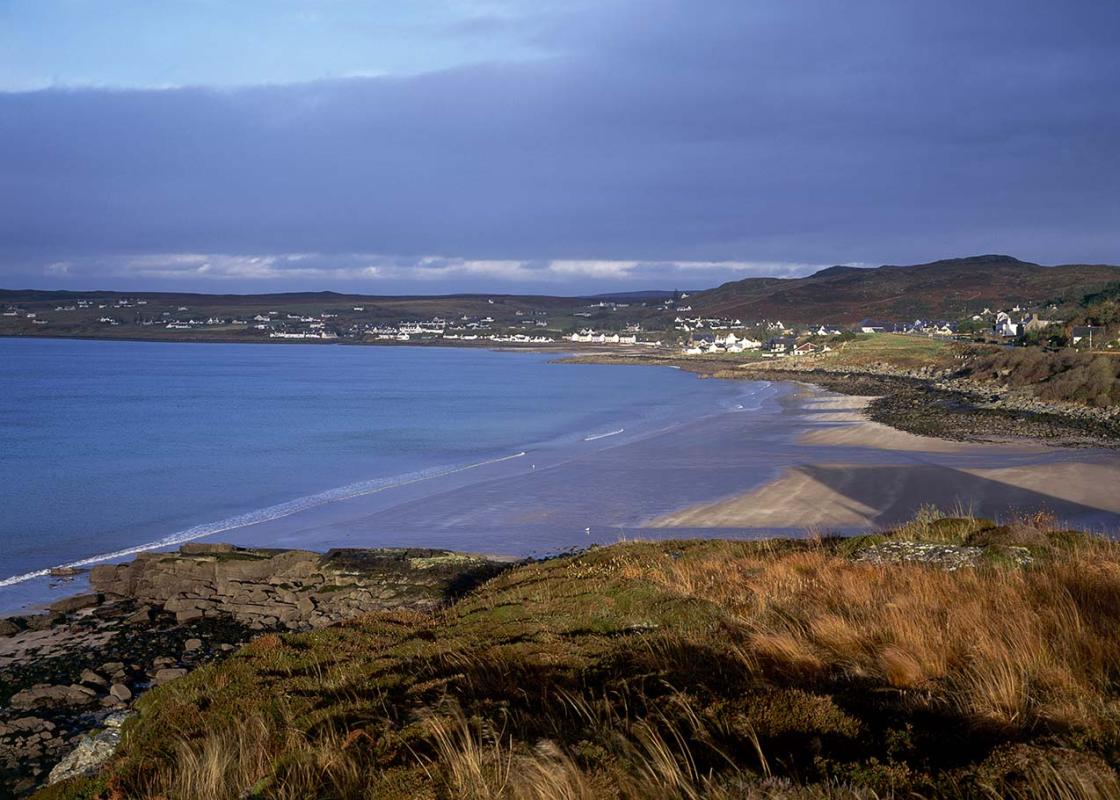
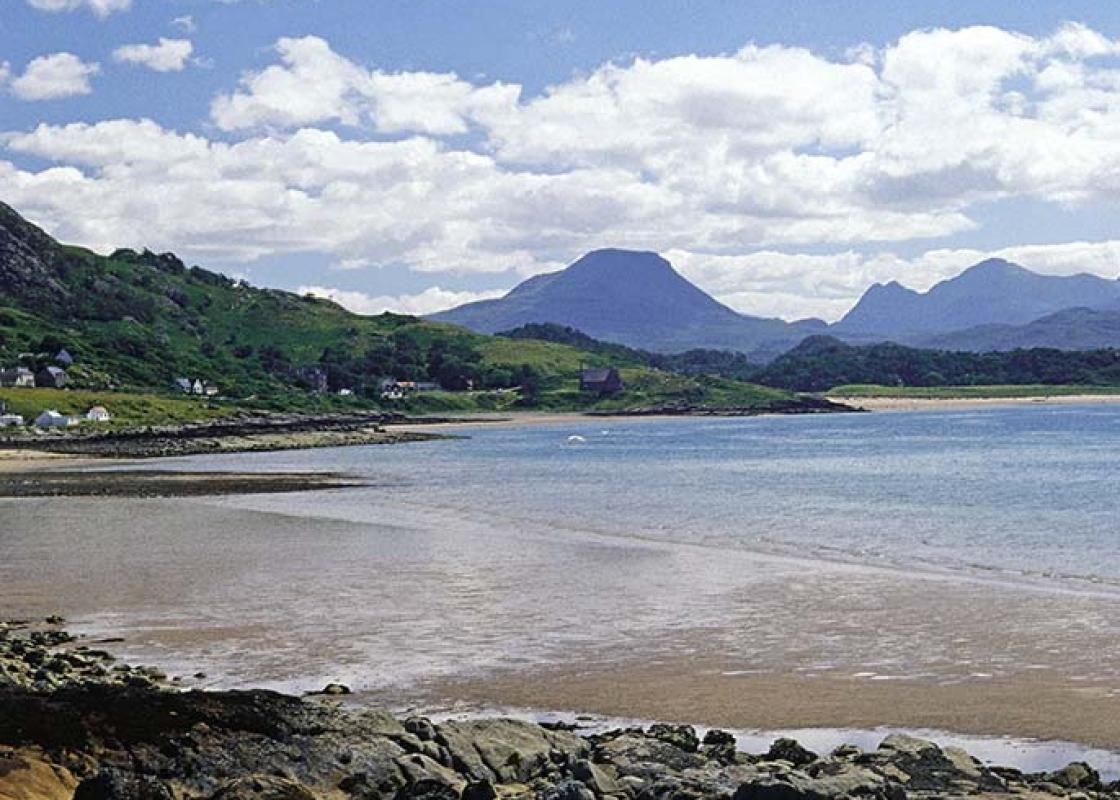
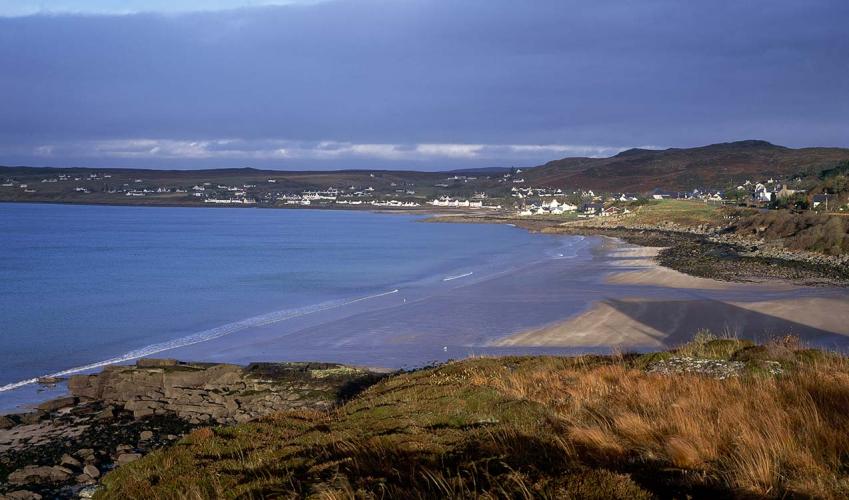
"Porpoise-watching along the Gairloch shore and up a rocky valley."
Walk directions
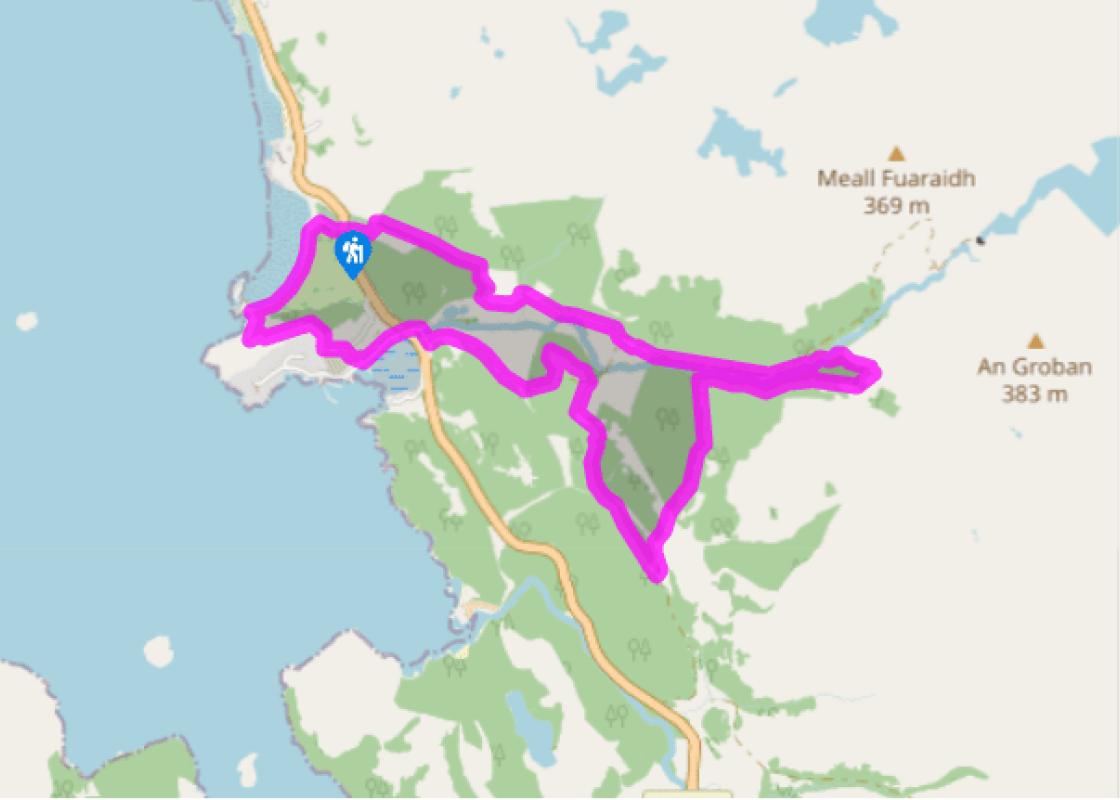
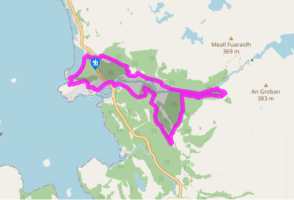
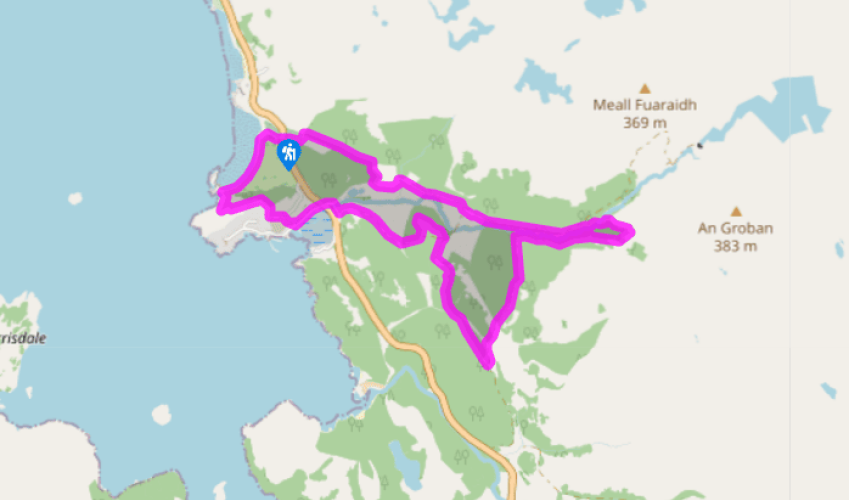
Cross the road and head up to the right of the Burial Ground. Turn left at its corner, going into trees to a path above. Turn right until a footbridge leads on to a wide path that soon runs downhill. The main path bends right (greentop waymarker) and runs down to a tarred driveway.
Turn left along a tarred track to pass Flowerdale House. The track passes to the left of a lovely old barn and turns right.
At Flowerdale Mains keep ahead on a smooth track. Where it bends uphill, keep ahead on a wide path, still to the left of the stream, to reach a footbridge built by the Royal Engineers, just before you get to Flowerdale Waterfall.
The path leads up past the waterfall to cross a footbridge above. It runs up into a windblown pine clump, then turns back down the valley. After another footbridge you pass a memorial to the blind piper of Gairloch, just before you reach a forest road. Turn left, away from the river valley, through felled forest that's regenerating naturally (with birch, alder, pine, willow and rowan).
After 0.5 miles (800m) gently uphill, a footbridge on the right is the start of a path back towards the river. It leads through scrub birch and bracken. The path bends right at an old fence corner post and goes down through bracken and birch to reach the valley floor at the corner of a walled paddock. Turn left on a grass track beside the wall, and cross a small stream to join a firm stony track.
Turn left for a few steps, until a small bracken path runs up to the right past a power pole with a faint blue paint mark. At the hilltop the path bends left under oaks, then left again as it drops to rejoin the firm track. This soon meets a larger track, which is the old road from Loch Maree to Gairloch. Turn right along this, through a couple of gates, to reach the The Old Inn at Charlestown.
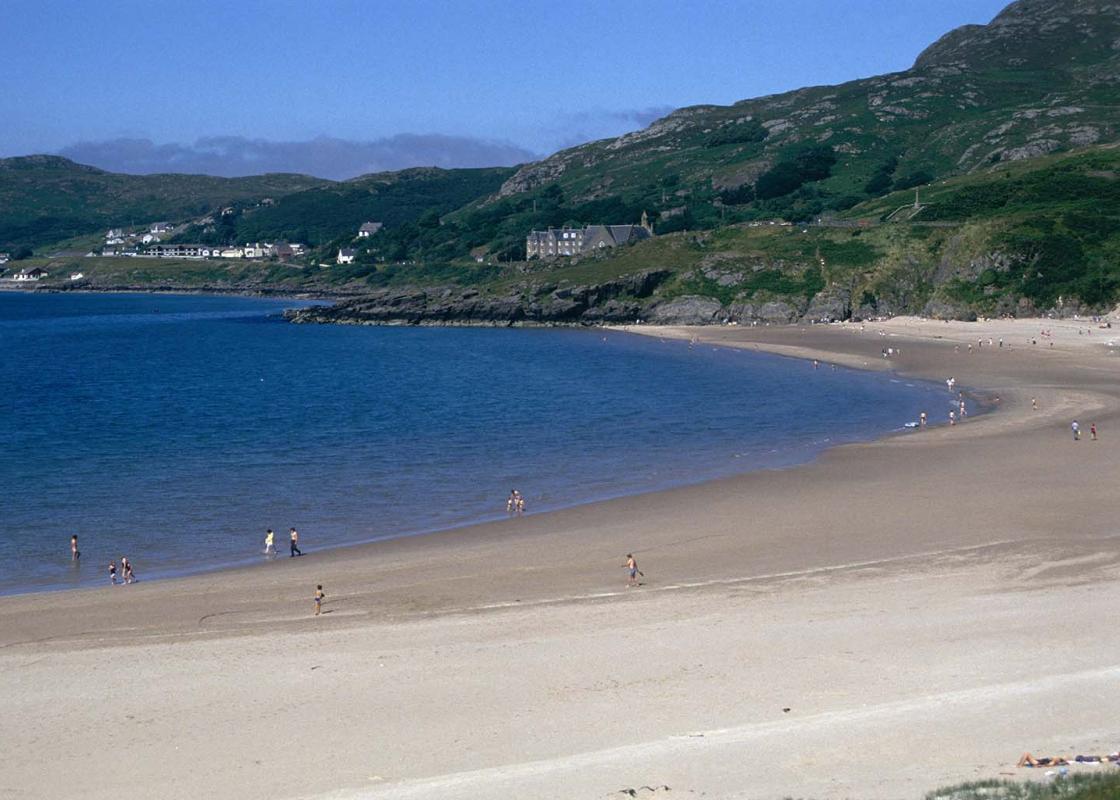
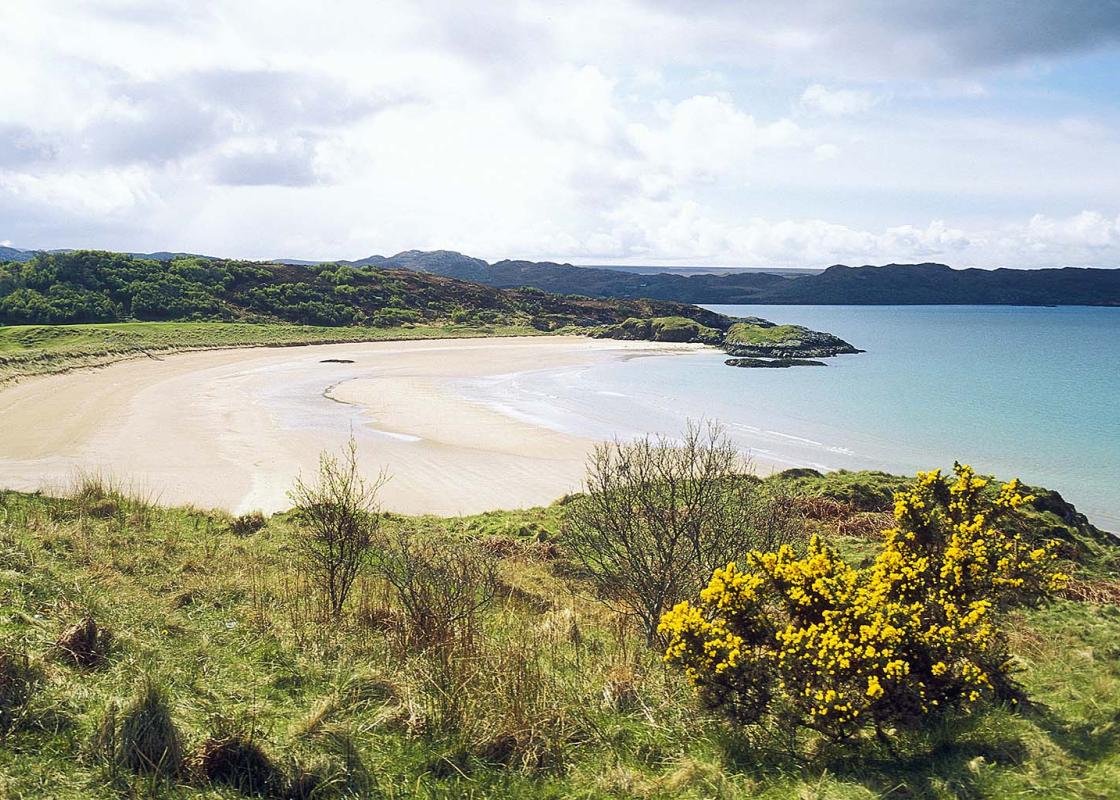
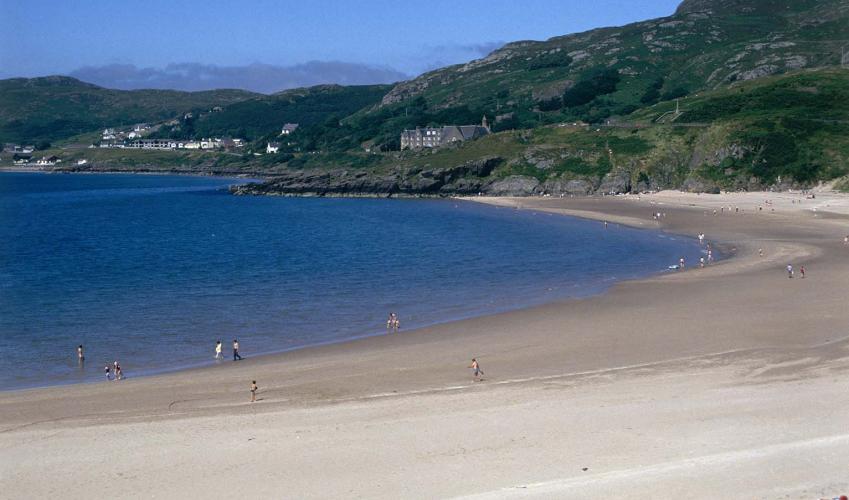
Cross the old bridge, and the main road, towards the piers. Turn right at the signpost for the beach, to a stepped path. The tarred path, signed for the beach, turns left above the piers, then turns right into the trees. It bends left again and emerges to run along the spine of a small headland. Just before being carried out to sea it turns sharp right at a signpost, and crosses above a rocky bay to the An Dùn Fort. A gravel path runs along the back of the beach, then turns right to the car park.
Additional information
Terrain
- Tracks and smooth paths, mostly waymarked
Landscape
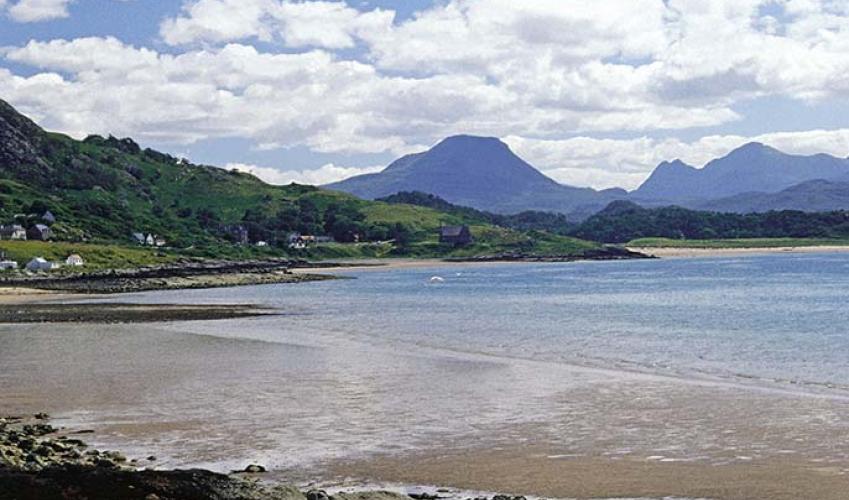
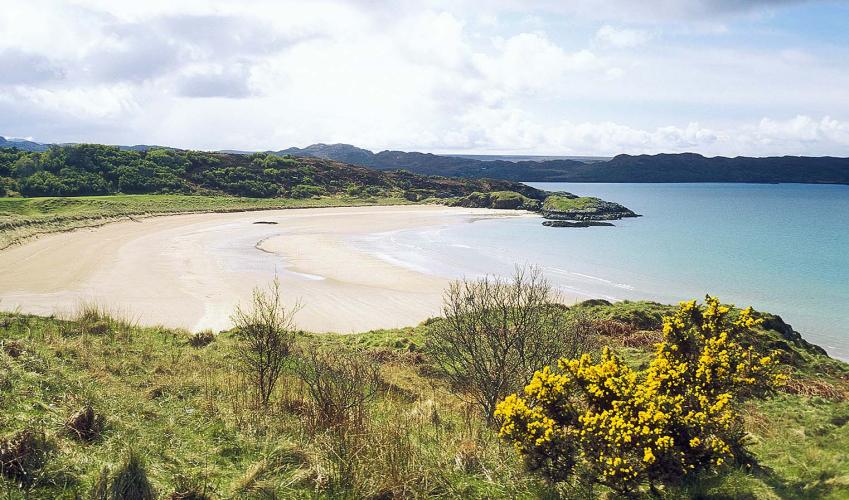
- Gentle river valley and rocky coast
Dog friendliness
- Keep on lead past Flowerdale House (as signs indicate)
Parking
- Beach car park, southern end of Gairloch
Toilets en route
- Walk start and Charlestown pier
About the walk
On a calm day in 1809, three fisherman drowned in Loch Ewe when their small boat was attacked and sunk by a whale. These waters are among the best in Europe for cetaceans (whales, dolphins and porpoises). The Gulf Stream brings warm, plankton-rich water and the swirling currents around the islands... bring nutrients to the surface. The plankton flourish; the fish eat the plankton; the whales and dolphins eat the fish. Porpoise or dolphin? The strongest currents are at headlands and narrow sea passages, so these are good places to look for marine wildlife. Calm days are best, and early morning best of all when looking west, as the low sunlight shines off their wet backs. On most summer days, either the harbour porpoise or common dolphin – or possibly both – can be seen, given a little patience, in Loch Gairloch. But which is which? At 6ft (2m) or less, the porpoise is smaller. It has a short, stubby fin compared with the dolphin's more elegant one. Harbour porpoises are normally shy, but the ones at Gairloch are untypically friendly, often approaching boats. Endangered in the world as a whole, the ones at Gairloch are doing well. What the future holds The whaling industry in Scotland ended in 1951, but serious threats remain. Dolphins and porpoises are accidentally caught in fishing nets, and floating plastic rope and old nets are another danger. Pollution from agriculture and forestry releases heavy metals and pesticides into the ocean. Fish farming is also probably damaging the dolphins. More fish sewage than human sewage goes into the Hebridean seas, all of it untreated, and anti-fouling paint on fish farms contributes more chemicals. Cetaceans use sound signals for finding fish, as well as for communication. Interference comes from ships, dredging nets, seismic oil exploration and underwater beepers fitted to fish farms to keep seals away. We don't know how well the dolphins and porpoises are doing. The growth of the whale-spotting industry means that we are just starting to discover how the populations are growing or declining. Marine tourism in Scotland today is a booming trade, supporting several hundred jobs. By going on one of these trips, you'll contribute to crucial research. A responsible boatman will not pursue the animals or steer into the middle of a group, but move quietly and wait for the dolphins to approach the boat.
Read more
Been on this walk?
Send us photos or a comment about this route. Or recommend a route of your own.

Walking in Safety
Read our tips to look after yourself and the environment when following this walk.
Get an AA guide
Explore our range of ‘50 Walks in’ guides - they’re the ideal companion for a ramble.
Been on this walk?
Send us photos or a comment about this route. Or recommend a route of your own.
Walking in Safety
Read our tips to look after yourself and the environment when following this walk.
Get an AA guide
Explore our range of ‘50 Walks in’ guides - they’re the ideal companion for a ramble.
About the area
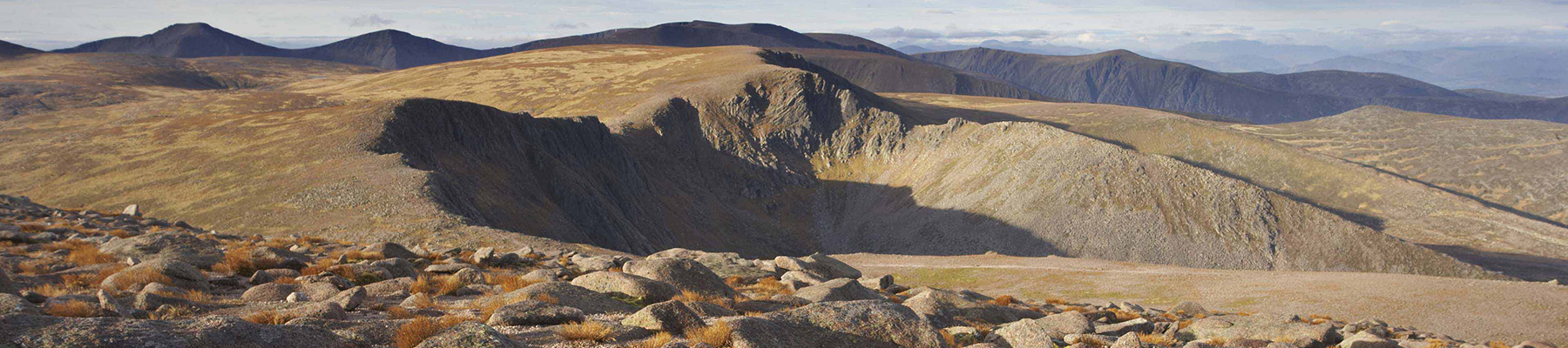
Apart from the Orkneys and the Shetlands, Highland is Scotland’s northernmost county. Probably its most famous feature is the mysterious and evocative Loch Ness, allegedly home to an ancient monster that has embedded itself in the world’s modern mythology, and the region’s tourist industry.
Nearby places to stay
View all (8)
Hotel
The Torridon
★★★★★
"The perfect getaway set amid loch and mountain scenery...."
- Family rooms: 0
- WiFi available
- Lift available
Restaurant with Rooms
The Dipping Lugger
★★★★★
"A comforting and comfortable loch-side former manse...."
- Rooms 3
- Free TV
- Wifi
- Open parking
Inn
The Arch Inn
★★★
"Continually improving inn with incredible sea views...."
- Rooms 10
- Satellite TV
- Free TV
- Wifi
Nearby places to stay
The Torridon
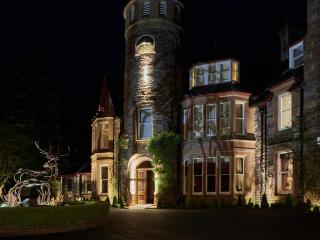
Delightfully set amid inspiring loch and mountain scenery, The Torridon is an elegant Victorian shooting lodge that's been beautifully appointed to make the most of its many original fe...
★★★★★ Rating
The Dipping Lugger
The Dipping Lugger overlooks Loch Broom in Ullapool. This 18th-century former manse has been transformed into a wonderful restaurant with rooms offering the highest levels of service as...
★★★★★ Rating
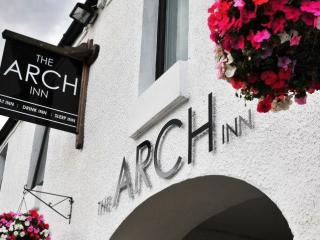
The Arch Inn
The Arch Inn is situated on Ullapool's waterfront on the shores of Loch Broom, only a two-minute walk from the Outer Hebrides ferry terminal. The accommodation provided is comfortable, ...
★★★ Rating
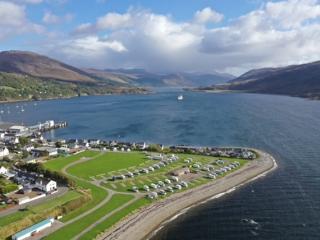
Broomfield Holiday Park
Broomfield Holiday Park is set right on the water's edge of Loch Broom and the open sea, with lovely views of the Summer Isles. This clean, well maintained and managed park is close to ...
★★★ Rating
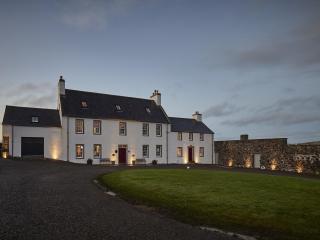
Monkstadt 1745 Restaurant with Rooms
Once a home of the Clan McDonald Chief and as a place of sanctuary for Bonnie Prince Charlie, Monkstadt 1745 has since been lovingly restored and turned into a charming restaurant with ...
★★★★★ Rating
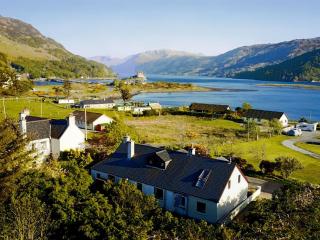
Eilean a’ Cheo Guest House
Eilean a' Cheo Guest House is situated in the village of Ardelve and enjoys stunning views across Loch Aish, to Eilean Donan Castle and the village of Dornie. Accommodation is split bet...
★★★★ Rating
Edinbane Lodge
Edinbane Lodge is a renovated 16th-century house designed to provide a luxurious and comfortable stay. The 6 rooms have been individually decorated with sumptuous woods, fabrics, textur...
★★★★★ Rating
Balmacara Hotel
Awaiting description....
Awaiting inspection
Places to eat nearby View all