"A romp through the barley with the reward of a local ale at the finish."
Walk directions
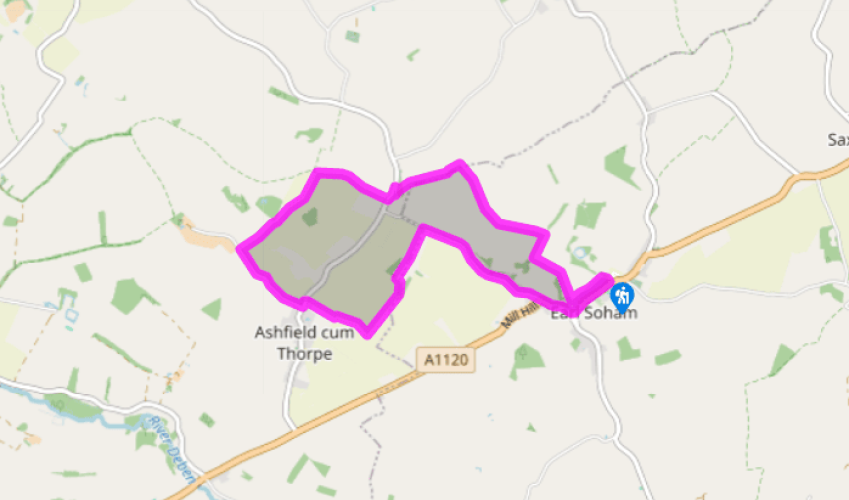
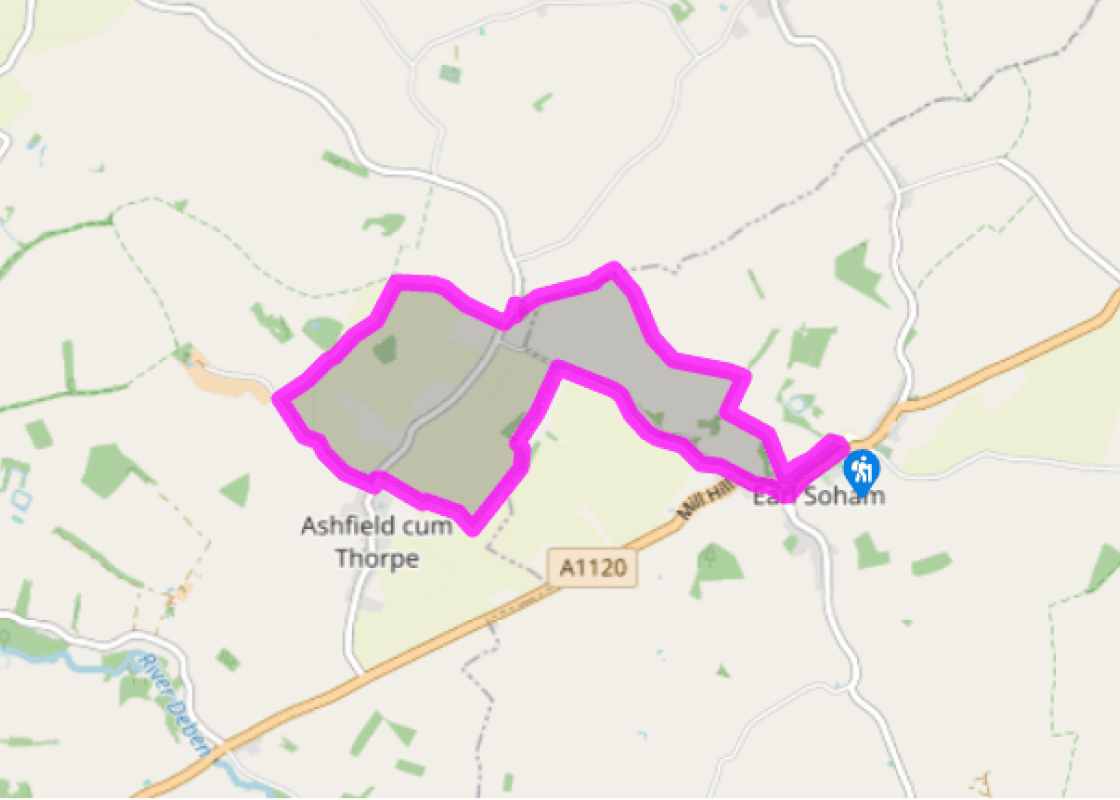
From the lay-bys, turn left off the A1120 by the village school and fork left on a tarmac drive. At the entrance to Earl Soham Lodge, turn left to pick up a field-edge path to the left of a fence that runs behind the village. Follow this path around the edge of a drained mere. Bear left at a telegraph pole, cross a footbridge, and stay on this path as it runs around the bottom of a field and turns uphill and to the right. Turn left after 200yds (182m) and walk beside a tall hedge to reach the poplar-lined drive of Windwhistle Farm. Come up here on a windy day and you will see how the farm got its name. Turn right and then left around the farm buildings to join a track to your left that leads past an isolated dark pink cottage and drops down to a valley. Turn left beyond the trees to walk along the left hand side of a ditch on the edge of the field. This takes a sharp left and right where it meets a hedge to skirt the edge of the field. Turn right through the hedge to cross two footbridges in a spinney to reach a road.
Turn left and then right on to a wide bridle path. Ignore the first footpath turning off to your left and take the next left shortly afterwards. This path climbs gently past a wind pump before taking in a pair of water towers.
When you reach a road (Grove Lane), turn left. At the end of the road, turn left and, in 60yds (55m), turn right along a field-edge path. Pass through a hedge to reach a second field. Seven-eighths of the way across this field, turn left on a path and continue across the crops. Keep straight ahead across a field, through a thicket and past a small pond. Pass next to a stile and keep going across the meadow between two fences to enter a green lane. The path bends left then goes through a kissing gate to descend through an avenue of young trees to another kissing gate, and a road.
Turn right and walk along this road for 0.75 miles (1.2km) into Earl Soham. When the A1120 joins from the right, cross the road, passing Cobbold Row, a terrace of timber-framed cottages named after a local brewer, and the Victoria pub. Continue along The Street, passing the village green, bowling green and tennis courts back to the start.
Earl Soham is a charming village hidden away in a valley along the old Roman road. Many people stop here just to visit the pub, which sells beer from the village brewery. It derives its ‘earl’ prefix from the fact that the village used to belong lock, stock and barrel to the Bigod family who were... earls of Norfolk. Soham, meanwhile, means ‘hamlet’ or ‘homestead by water’. It’s a designated Conservation Area nowadays and boasts a good number of venerable cottages and houses. The village has a long history stretching back to Saxon times. Felix, the Bishop of Dunwich, was an occasional resident here until his death in 647. He is said to have been buried at a monastery at Earl Soham that was later completely destroyed by Danish hordes. Abbot Althelstan retrieved the bones of poor Felix and had them re-interred at his own abbey at Ramsey in Cambridgeshire. At least, that’s probably what happened. Some historians have queried this and claim that there has actually been a mix up at some point down the years and that these events occurred at Monk Soham rather than Earl Soham. Richard Wyard One story that we know definitely occurred in Earl Soham is that of Richard Wyard. A native of the village, he became a captain in the merchant navy and on one voyage twice came within a hair’s breadth of being shipwrecked. In grateful thanks for his narrow escapes, he made a bequest in 1677 of an annual sum of £5 to be distributed after the preaching of a particular sermon which had to be given on both 25 February and 23 April (the dates on which the wrecks nearly occurred). Aptly enough, the text of the sermon was Psalm 107.23-24: Some went out on the sea in ships; they were merchants on the mighty waters.They saw the works of the Lord, his wonderful deeds in the deep. Earl Soham Brewery Since 2001, the village brewery has been housed in the Old Forge opposite the village green – a building which, having been a forge, had served time as a garage and then an upholsterer. However, the brewery began life in 1985 in an old chicken shed behind Earl Soham’s pub, The Victoria. Its range of beers includes Victoria Bitter, Albert Ale, Gannet Mild and something called Jolabrugg. Aspall Hall The Earl Soham village shop offers a fine range of local produce including organic cider and apple juice from Aspall Hall near Debenham. Aspall is one of the oldest family firms in England, founded by Clement Chevallier in 1728 and still run by the eighth generation of the Chevallier family. The business has remained on the same site throughout its history and the original apple press and stone trough are still at Aspall Hall.
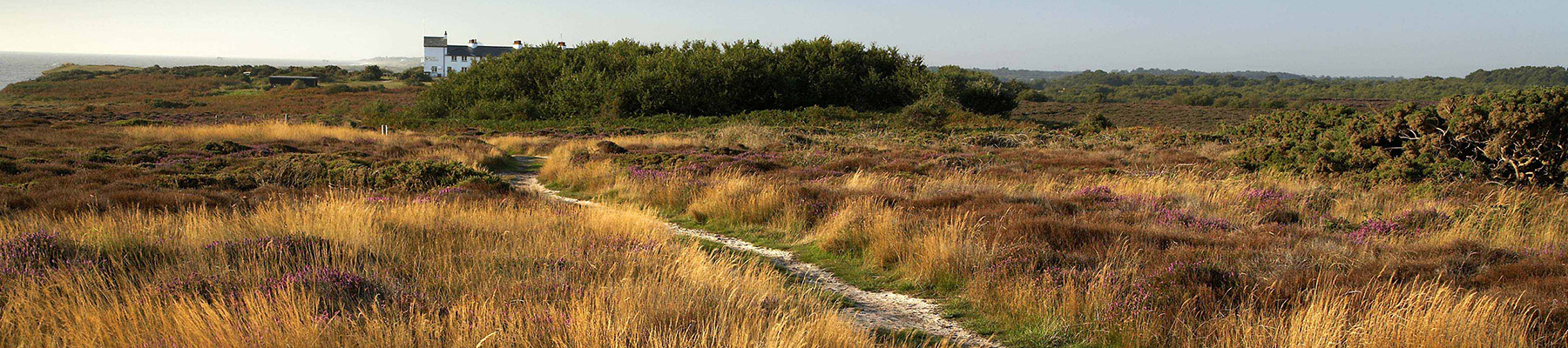
Suffolk is Constable country, where the county’s crumbling, time-ravaged coastline spreads itself under wide skies to convey a wonderful sense of remoteness and solitude. Highly evocative and atmospheric, this is where rivers wind lazily to the sea and notorious 18th-century smugglers hid from the excise men.
"A romp through the barley with the reward of a local ale at the finish."
Walk details
2hrs 15min
Difficulty:
Easy
Gradient:
Moderate
Distance:
5.25 miles (8.4kms)
Ascent:
131ft (40m)
Walk directions
From the lay-bys, turn left off the A1120 by the village school and fork left on a tarmac drive. At the entrance to Earl Soham Lodge, turn left to pick up a field-edge path to the left of a fence that runs behind the village. Follow this path around the edge of a drained mere. Bear left at a telegraph pole, cross a footbridge, and stay on this path as it runs around the bottom of a field and turns uphill and to the right. Turn left after 200yds (182m) and walk beside a tall hedge to reach the poplar-lined drive of Windwhistle Farm. Come up here on a windy day and you will see how the farm got its name. Turn right and then left around the farm buildings to join a track to your left that leads past an isolated dark pink cottage and drops down to a valley. Turn left beyond the trees to walk along the left hand side of a ditch on the edge of the field. This takes a sharp left and right where it meets a hedge to skirt the edge of the field. Turn right through the hedge to cross two footbridges in a spinney to reach a road.
1 of 4
Turn left and then right on to a wide bridle path. Ignore the first footpath turning off to your left and take the next left shortly afterwards. This path climbs gently past a wind pump before taking in a pair of water towers.
2 of 4
When you reach a road (Grove Lane), turn left. At the end of the road, turn left and, in 60yds (55m), turn right along a field-edge path. Pass through a hedge to reach a second field. Seven-eighths of the way across this field, turn left on a path and continue across the crops. Keep straight ahead across a field, through a thicket and past a small pond. Pass next to a stile and keep going across the meadow between two fences to enter a green lane. The path bends left then goes through a kissing gate to descend through an avenue of young trees to another kissing gate, and a road.
3 of 4
Turn right and walk along this road for 0.75 miles (1.2km) into Earl Soham. When the A1120 joins from the right, cross the road, passing Cobbold Row, a terrace of timber-framed cottages named after a local brewer, and the Victoria pub. Continue along The Street, passing the village green, bowling green and tennis courts back to the start.
Earl Soham is a charming village hidden away in a valley along the old Roman road. Many people stop here just to visit the pub, which sells beer from the village brewery. It derives its ‘earl’ prefix from the fact that the village used to belong lock, stock and barrel to the Bigod family who were... earls of Norfolk. Soham, meanwhile, means ‘hamlet’ or ‘homestead by water’. It’s a designated Conservation Area nowadays and boasts a good number of venerable cottages and houses. The village has a long history stretching back to Saxon times. Felix, the Bishop of Dunwich, was an occasional resident here until his death in 647. He is said to have been buried at a monastery at Earl Soham that was later completely destroyed by Danish hordes. Abbot Althelstan retrieved the bones of poor Felix and had them re-interred at his own abbey at Ramsey in Cambridgeshire. At least, that’s probably what happened. Some historians have queried this and claim that there has actually been a mix up at some point down the years and that these events occurred at Monk Soham rather than Earl Soham. Richard Wyard One story that we know definitely occurred in Earl Soham is that of Richard Wyard. A native of the village, he became a captain in the merchant navy and on one voyage twice came within a hair’s breadth of being shipwrecked. In grateful thanks for his narrow escapes, he made a bequest in 1677 of an annual sum of £5 to be distributed after the preaching of a particular sermon which had to be given on both 25 February and 23 April (the dates on which the wrecks nearly occurred). Aptly enough, the text of the sermon was Psalm 107.23-24: Some went out on the sea in ships; they were merchants on the mighty waters.They saw the works of the Lord, his wonderful deeds in the deep. Earl Soham Brewery Since 2001, the village brewery has been housed in the Old Forge opposite the village green – a building which, having been a forge, had served time as a garage and then an upholsterer. However, the brewery began life in 1985 in an old chicken shed behind Earl Soham’s pub, The Victoria. Its range of beers includes Victoria Bitter, Albert Ale, Gannet Mild and something called Jolabrugg. Aspall Hall The Earl Soham village shop offers a fine range of local produce including organic cider and apple juice from Aspall Hall near Debenham. Aspall is one of the oldest family firms in England, founded by Clement Chevallier in 1728 and still run by the eighth generation of the Chevallier family. The business has remained on the same site throughout its history and the original apple press and stone trough are still at Aspall Hall.
Suffolk is Constable country, where the county’s crumbling, time-ravaged coastline spreads itself under wide skies to convey a wonderful sense of remoteness and solitude. Highly evocative and atmospheric, this is where rivers wind lazily to the sea and notorious 18th-century smugglers hid from the excise men.